Buy tokens
Buy tokens



Verified phones in Africa and Asia, working only while idle, charging and connected. Providers are paid in stablecoin per unit of checked work.

Buyers anywhere pay world prices for batch work through an API, a rate card and an SLA. They never see a phone.

Brydg keeps a 30% take on provider payouts. 15% of that revenue accrues to token holders in stablecoin the moment each job settles.

A buyer submits a job through the API: batch AI inference, data processing, verification. The price locks and payment is held in stablecoin.

The job splits into device-sized units, assigned to verified phones that are idle, charging and connected, overnight, while their owners sleep.

Every unit runs on at least two devices and is checked against known answers. Failed units re-run automatically. Bad results never reach the buyer.

Verified results are assembled and delivered by the deadline. The buyer sees an API, a rate card and an SLA. Never a phone.

Devices with uptime and clean results earn priority scheduling and higher rates. The fleet gets more reliable the longer it runs.

At settlement, everyone is paid at once: the provider in stablecoin, Brydg's markup booked, and 15% of it accrued to token holders, automatically.
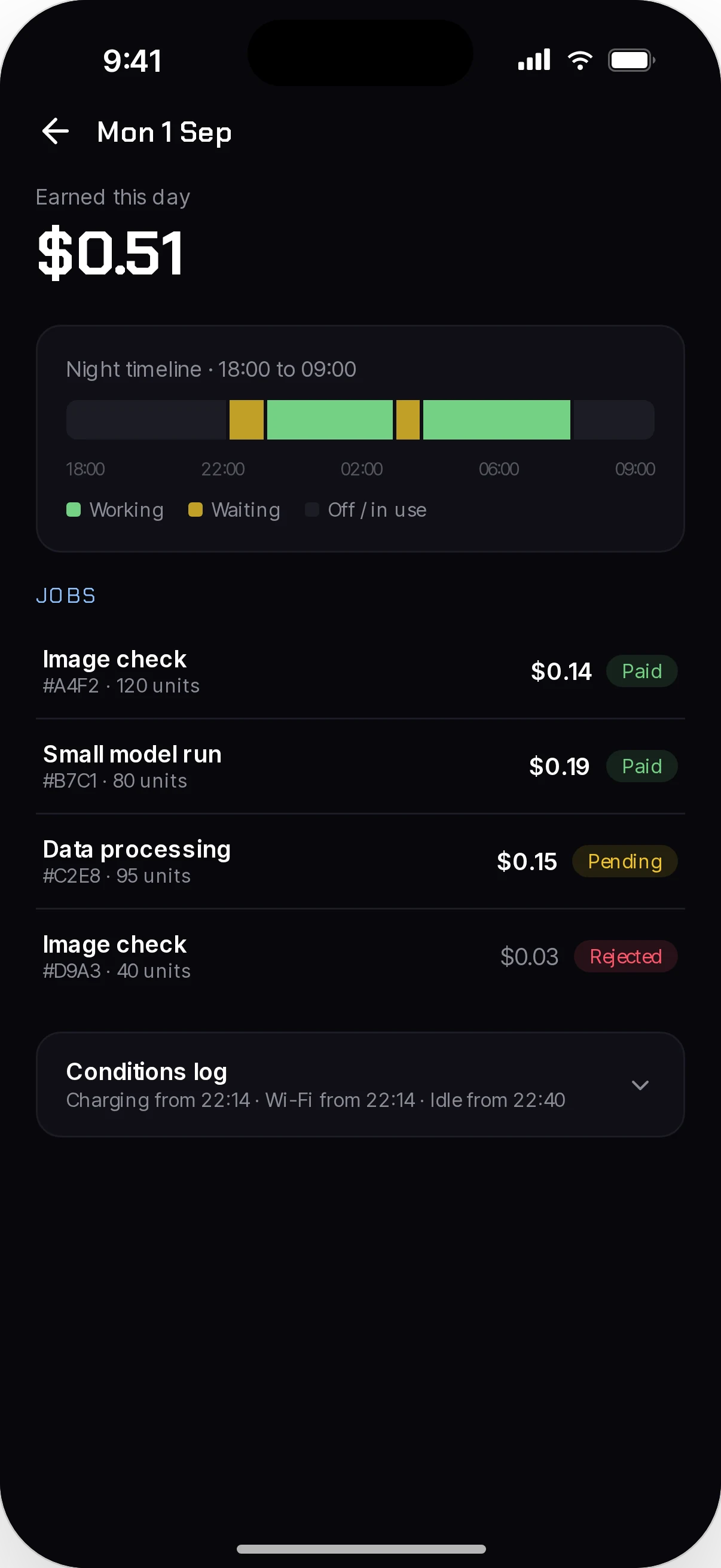
Units, state, and the check it passed or failed. Every unit runs on at least two devices and is compared against known answers; a rejected unit is not paid. Screen from the app design, figures made up.
No device is ever recruited into a network with nothing to pay it. Corridors open against contracted work, so no phone joins a fleet with nothing to earn.

Each pre-sale stage's proceeds are the budget until the next milestone unlocks the next stage. We never spend capital we haven't raised, and we publish no revenue projection until a signed contract and a unit price exist.
Phones are not data centres, and Brydg never pretends otherwise. They absorb the overflow that data centres cannot serve economically: work that can wait until tonight and be checked in the morning.

Small-model inference in batches: classification, embedding, extraction and moderation queues that run overnight and land by morning.

Transformations, deduplication, cross-checks and validation passes over large datasets, split across thousands of devices.

Cryptographic and zero-knowledge proof workloads that parallelise cleanly and verify cheaply.

Frames and tiles rendered in parallel and reassembled, where cost matters more than speed.

Agent and model tasks run inside phone secure enclaves, so the workload is attested and its data never leaves the hardware.

No model training, no latency-critical serving. If a job needs a GPU cluster and an answer in 50 milliseconds, it belongs in a data centre. Everything else is overflow.
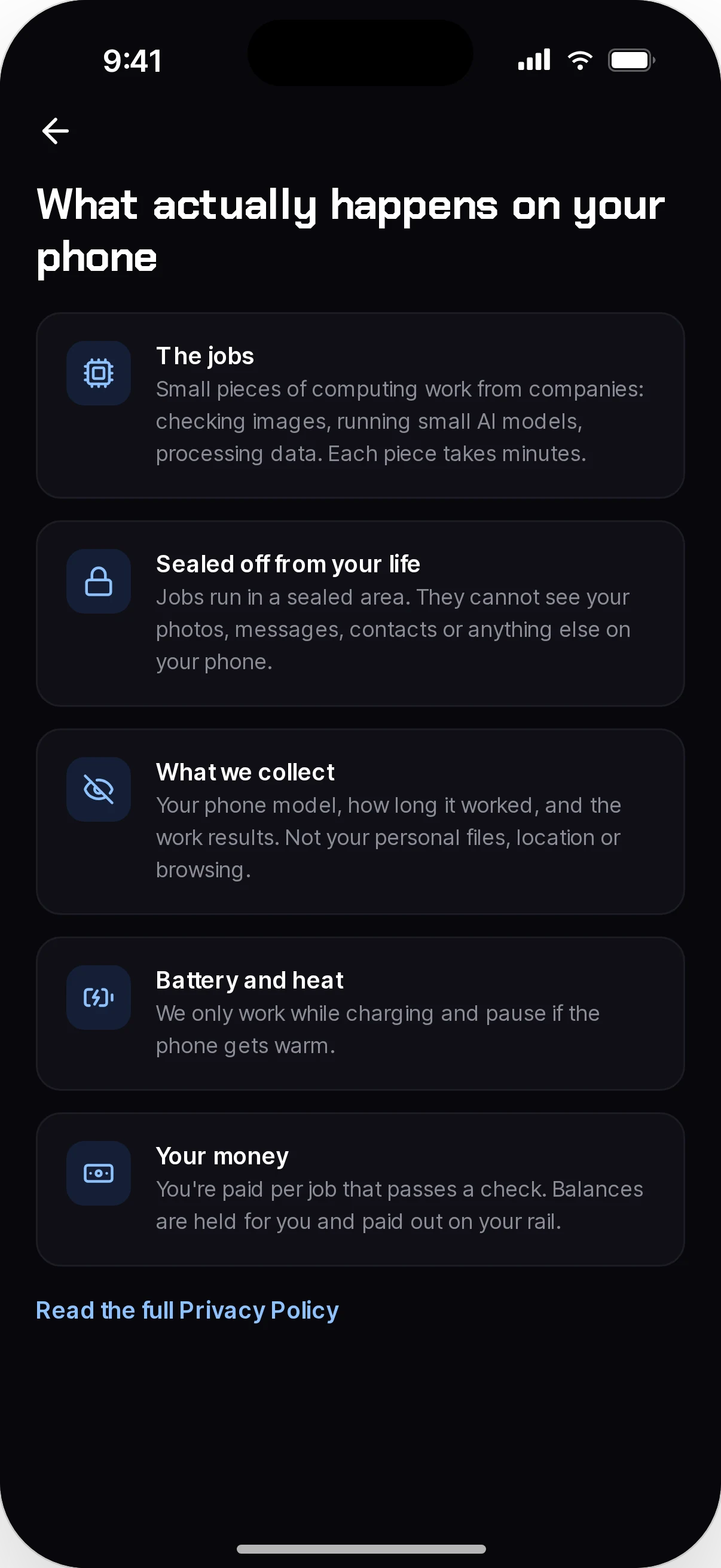
Jobs run sealed off from photos, messages and contacts; confidential workloads run inside the phone's secure enclave. Brydg collects the phone model, hours worked and work results, not files, location or browsing. Work happens only while charging and pauses on heat. Pay is per job that passes a check.
Brydg sells to buyer types in the order they already pay for consumer-device compute, and refuses to forecast until a contract exists.
Protocols and infrastructure teams already paying consumer-device networks in stablecoin for verification, proofs and batch inference. First contracts come from here.
Batch workloads behind a developer API and a published rate card: overnight processing, embeddings, moderation and verification at a price data centres cannot match.
Regional processors and enterprises with recurring batch needs, reached once the network has a track record, uptime history and reference customers.
Hundreds of millions of capable Android phones already exist in the markets Brydg launches in. Getting them onto the network, verified and paid, is a distribution problem, and it is solved the way phones are already sold.
Each launch market gets its own acquisition budget, agent network, connectivity arrangement and local payout rail. Corridors open one by one, only against contracted work, then Asia.
Participation packaged into phone plans with off-peak data allowances. Telcos take a share of the take on every unit their subscribers execute: a new revenue line with zero capex, and a 35% take on bundled cohorts.
Field agents onboard providers in person, and operators run many verified devices as a micro-business. Both are paid from revenue, never in tokens.
Phones as real compute: proven. AI demand paying consumer networks in stablecoin: proven, profitably. The payout rails: already moving trillions. And the discipline: 2021's projection-priced tokens are down 94 to 99% while real networks' revenues grew, so Brydg is built to be judged on revenue. It combines the proven pieces.


Acurast runs 225,000+ smartphones as compute nodes across 140+ countries, executing confidential workloads inside phone secure enclaves and settling in USDC. Source: Acurast network data, 2026.
Fixed supply. 15% of gross revenue, first claim, in stablecoin. No vesting on anything you buy in the pre-sale.
See the tokenOne email when a stage is about to open or a milestone unlocks. Nothing else, and never a request for funds or keys.